Showing posts with label Clarence Thomas. Show all posts

Sunday, December 14, 2014

Unions Just Got A Big Legal Victory Handed To Them By… Clarence Thomas?

In writing the opinion of Integrity Staffing Solutions Inc. vs. Busk et. al, Justice Clarence Thomas clearly was not thinking about handing unions a powerful new tool for unionizing. Instead he was thinking about how it was fine for any company to restrain and employee for hours each week without any compensation. But, in his wording, he may have just struck down right-to-work laws nationwide without realizing it.
These arguments are properly presented to the employer at the bargaining table, see 29 U.S.C., 254(b)(1), not to a court in an FLSA claim.
Per this section of US Code, the issue of a workplace retaining an employee without compensation for hours each week is one which must be handled in negotiations between the employer and the employee, their agent or their collective bargaining representative. This statement, as simple as it is, has a lot of weight behind it due to the nature of the case behind it. By retaining the full text of the Fair Labor Standards Act (FLSA), combined with this decision, the entire workplace dynamic for collective bargaining just changed overnight.

The case itself involves contractors at an Amazon warehouse facility, who can take considerable time each day to go through security checkpoints in order to leave their jobs. The warehouse itself is not unionized, and Amazon is firmly against unions.

Clarence Thomas just put into a court decision that workplace issues involving compensated time must be handled in negotiations, the cornerstone of collective bargaining and unions, and not the courts. By blocking the courts, but with FLSA itself upheld This also means that companies can no longer fail to engage in negotiations, relying upon the courts to handle such matters – the Supreme Court just ordered them to the bargaining table. Tactics to block unionizing now can, and will be considered unconstitutional per this decision.

Laws like Right-To-Work, where an employee can avoid joining a union, now no longer can apply in the way intended. The Supreme Court just ordered people to the bargaining table, the Union representative, with but a few short words.

Wednesday, February 26, 2014

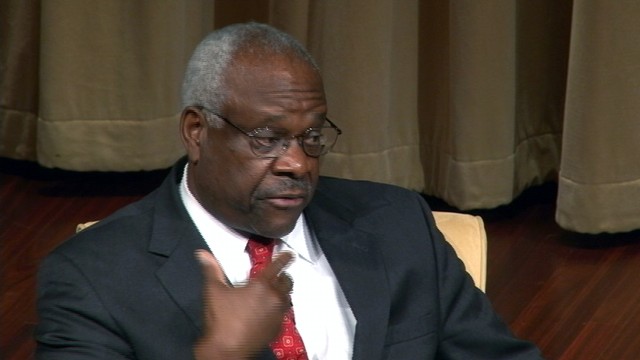
Clarence Thomas: Supreme Court Sphinx

Except for a few choice seats, the view of the court bench from the press gallery is largely blocked by pillars that run down the side of the room, so experienced reporters learn to identify justices by their voices.
It was with shock, then, that we heard a speaker we didn't immediately recognize. Was that Clarence Thomas? We asked in whispers, then began scribbling furiously in our notebooks. An already interesting case in 2002 about the constitutionality of anti-cross-burning statutes suddenly became one of the top headlines of the day.
On Saturday it will have been eight years since Mr Thomas has said more than a joking aside during arguments - a length of time that Supreme Court watcher Jeffrey Toobin calls "demeaning to the court" in a piece for the New Yorker.
At least, Toobin writes, Mr Thomas used to feign interest in the proceedings.
"These days, Thomas only reclines; his leather chair is pitched so that he can stare at the ceiling, which he does at length," he writes. "He strokes his chin. His eyelids look heavy. Every schoolteacher knows this look. It's called 'not paying attention.'"
Toobin notes that despite his silence, Mr Thomas has had an influence on American law.
"For better or worse, Thomas has made important contributions to the jurisprudence of the Supreme Court," he writes. "He has imported once outre conservative ideas, about such issues as gun rights under the Second Amendment and deregulation of political campaigns, into the mainstream."
Writing opinions, Toobin contends, isn't the only job of high court justices, however. They have a responsibility to air their thinking in public, through the oral argument format.
"Imagine, for a moment, if all nine Justices behaved as Thomas does on the bench," he writes. "The public would rightly, and immediately, lose all faith in the Supreme Court. Instead, the public has lost, and should lose, any confidence it might have in Clarence Thomas."
Conservative commentator Erick Erickson tweeted that Toobin's argument is "rather silly".
"Justice Thomas has repeatedly made clear why he does not engage like the others," he writes.
And indeed he has. Outside of the courtroom, Mr Thomas hasn't been silent - although he clearly prefers to speak to friendly conservative and academic audiences.
When asked about his lack of interaction during oral arguments, he has said it's out of respect for the lawyers, whom he doesn't want to "badger".
"I think it's an opportunity for the advocate, the lawyers, to fill in the blanks, to make their case," he said during a 2009 television interview. "I think you should allow people to complete their answers and their thought, and to continue their conversation. I find that coherence that you get from a conversation far more helpful than the rapid-fire questions."
The reality is that, with lifetime tenure, Supreme Court justices are going to do as they please, with little regard for what magazine writers may think. If they were to suggest that by singing show tunes lawyers would have a greater chance of winning their cases, Luck Be a Lady Tonight would ring regularly through the court's marble halls.
Related Posts Plugin for WordPress, Blogger...