
Showing posts with label HIV. Show all posts
Showing posts with label HIV. Show all posts
Sunday, March 15, 2015

Saturday, January 17, 2015
HIV and AIDS -- The Facts
HIV is a virus which attacks the immune system, and weakens your ability to fight infections and disease. It's most commonly caught by having sex without a condom.
It can also be passed on by sharing infected needles and other injecting equipment, and from an HIV-positive mother to her child during pregnancy, birth and breastfeeding.
HIV stands for human immunodeficiency virus. The virus attacks the immune system, and weakens your ability to fight infections and disease.
There is no cure for HIV, but there are treatments to enable most people with the virus to live a long and healthy life.
AIDS is the final stage of HIV infection, when your body can no longer fight life-threatening infections. With early diagnosis and effective treatment, most people with HIV will not go on to develop AIDS.
How do you get HIV?
HIV is found in the body fluids of an infected person, which includes semen, vaginal and anal fluids, blood, and breast milk. It is a fragile virus and does not survive outside the body for long.
HIV cannot be transmitted through sweat or urine.
The most common way of getting HIV in the UK is by anal or vaginal sex without a condom. According to statistics from the Health Protection Agency, 95% of those diagnosed with HIV in the UK in 2011 acquired HIV as a result of sexual contact.
Other ways of getting HIV include:
- using a contaminated needle, syringe or other injecting equipment
- tranmission from mother to baby during pregnancy, birth or breastfeeding
- through oral sex or sharing sex toys (although the risk is significantly lower than for anal and vaginal sex)
Getting tested
Friday, January 16, 2015
CDC Releases Annual STD Surveillance Report
(Source:cdc.gov)
In the battle against HIV/AIDS, many people often forget or dismiss other sexually transmitted infections like chlamydia, gonorrhea and syphilis, which go undiagnosed and can increase the likelihood of contracting HIV. Toward the end of December 2014, the Centers for Disease Control and Prevention released their 2013 data of STDs in the United States. The data are based on state and local STD case reports from a variety of private and public sources. They indicate that the majority of these cases are not being reported in STD clinics, but rather in private physician offices or health organizations.
Many cases of chlamydia, gonorrhea, and syphilis continue to go undiagnosed and unreported, and data on several additional STDs, such as human papillomavirus, herpes simplex virus, and trichomoniasis, are not routinely reported to CDC. As a result, the annual surveillance report captures only a fraction of the true burden of STDs in America. However, it provides important insights into the scope, distribution, and trends in STD diagnoses in the country.
STDs are a significant health challenge facing the United States. CDC estimates that nearly 20 million new sexually transmitted infections occur every year in this country, half among young people ages 15-24, accounting for almost $16 billion in health care costs. Each of these infections is a potential threat to an individual's immediate and long-term health and well-being. In addition to increasing a person's risk for acquiring and transmitting HIV infection, STDs can lead to severe reproductive health complications, such as infertility and ectopic pregnancy.
There is good news for infections of chlamydia and gonorrhea, as reported cases went down. In 2013, there were 1,401,906 reported cases of chlamydia, a decrease of 1.5 percent since 2012. Gonorrhea also decreased, with 333,004 reported cases in 2013, a 0.6 percent decrease from the year before.
But syphilis, both primary, secondary and congenital, went up. In 2013, there were 17,375, a 10 percent increase since 2012. Worse still, this national rate increase was only found among men, particularly gay and bisexual men.
(Source:cdc.gov)
Some Groups Bear a Disproportionate Burden
While anyone can become infected with an STD, certain groups, including young people and gay and bisexual men, are at greatest risk. Gonorrhea and chlamydia primarily affect young people.
While surveillance data show signs of potential progress in reducing chlamydia and gonorrhea among young people aged 15-24, both the numbers and rates of reported cases of these two diseases continue to be highest in this group compared to other age groups.
Both young men and young women are heavily affected by STDs, but young women face the most serious long-term health consequences. It is estimated that undiagnosed STDs cause 24,000 women to become infertile each year.
The other group facing the burden of STDs are men who have sex with men (MSM). There has been a troubling rise in syphilis infections among gay, bisexual, and other MSM. Trend data show that MSM account for three quarters (75 percent) of all primary and secondary syphilis cases.
Primary and secondary syphilis are the most infectious stages of the disease, and if not adequately treated, can lead to long-term infection, which can cause visual impairment and stroke. Syphilis infection can also place a person at increased risk for acquiring or transmitting HIV infection. In fact, available surveillance data indicate that an average of half of MSM with syphilis are also infected with HIV.
Disparities result from a range of factors, including individual risk behaviors (such as higher numbers of lifetime sex partners), as well as environmental, social and cultural factors (such as higher prevalence of STDs or difficulty accessing health care) contribute to disparities in the sexual health of MSM.
For example, MSM with lower economic status may have trouble accessing and affording quality healthcare, making it difficult to receive STD testing and other prevention services. Additionally, complex issues like homophobia and stigma can also make it difficult for gay and bisexual men to find culturally-sensitive and appropriate care and treatment.
One thing is certain: STD screening is critical. If you are sexually active, be sure to talk to your healthcare provider about STD testing and which tests may be right for you.
If you are a sexually active woman younger than 25, or have risk factors such as multiple sex partners, you should request annual chlamydia and gonorrhea tests. If you're pregnant, you should request syphilis, HIV, chlamydia and hepatitis B tests early in your pregnancy. If you have new or multiple sex partners, you should also request gonorrhea testing early in pregnancy.
Sexually active MSM should request tests for syphilis, chlamydia, gonorrhea and HIV at least once a year. More frequent STD testing is recommended for men at high risk.
For more information, or to read the complete report, visit http://www.cdc.gov/std/stats13/toc.htm
Tuesday, December 30, 2014
AHF Continues Anti-PrEP Rhetoric With New Ad
For two years Justin* was known as a bug chaser - someone who intentionally tried to get infected with HIV. He figured he was going to get it anyway, since he never wore condoms, and was a bottom.
During that time period the 23-year-old that lives in Chicago met several positive men who were more than willing to infect him.
They didn't succeed.
"I spent a good couple of years bug chasing. I can't really give you a logical reason why. I just wanted to get it and get it done and over with," he said. "I was talking to a guy online who told me had HIV. I know this sounds horrible, but I was kind of turned on by it. He said 'If you're going to bareback you're eventually going to get it.' And so that's when I started to try."
After a couple of friends found out about his behavior and berated him for it, their opinions eventually struck a chord with him and he started to feel ashamed of his behavior.
But just because he started to have a change of heart didn't mean he was going to start wearing condoms.
"I've never been one to wear a condom. I never liked them. They're uncomfortable," he said.
For some unexplainable reason the "condom talk" never resonated with Justin no matter how many times, or people, told him he should use one.
And that's when he found out about pre-exposure prophylaxis, more commonly known as PrEP when preventing HIV.
Justin now considers himself a "reformed bug chaser."
Thursday, December 11, 2014
Spanish Doctors Believe They've Found a Cure for HIV
Donors with a CCR5 mutation can help prevent HIV (Source:scienceblogs.com)
Doctors in Barcelona, Spain believe that they have found a possible cure for HIV via a blood transfer from a donor with a genetic mutation, but researchers warn that it's going to be a long time coming.
HIV Plus Magazine reports that the Spanish research team is following the similar hypothesis to Harvard researchers who believe that a blood transplant from a donor with the CCR5 Delta 32 genetic mutation could "close the door" on HIV, as it prevents HIV from entering healthy white cells and replicating. This mutation occurs in about 1 percent of the population.
The announcement was spurred by encouraging results in the experimental treatment given to a 37-year-old man who contracted HIV in 2009. This "Barcelona Patient" developed lymphoma in 2012, and when he received his transplant of umbilical cord blood, doctors made sure it was from a donor with the CCR5 Delta 32.
"We suggested a transplant of blood from an umbilical cord but from someone who had the mutation because we knew from 'the Berlin patient' that as well as [ending] the cancer, we could also eradicate HIV," Rafael Duarte, the director of the Haematopoietic Transplant Programme at the Catalan Oncology Institute in Barcelona, explained to Spanish news site The Local.
As in the case of the "Berlin Patient," Timothy Ray Brown, the HIV-positive man who experienced a bone marrow transplant from a donor with the mutation and remains cured of both leukemia and HIV six years later.
Unfortunately, the "Barcelona Patient" wasn't so lucky; he died of cancer. But he remained HIV free three months after his transplant, spurring doctors at Spain's National Transplant Organization to back the world's first clinical trials of umbilical cord blood transplants for HIV patients with blood cancers, as reported by the Latin Post.
Javier Martínez, a virologist from the research foundation Irsicaixa, is quoted as saying that while their trials are aimed at helping HIV-positive cancer patients but it could "allow us to speculate about a cure for HIV." March 2015 will mark the beginning of these trials.
Tuesday, December 9, 2014
PASTOR SUGGESTS KILLING ALL GAYS SO WORLD CAN HAVE AN AIDS-FREE CHRISTMAS
Arizona pastor Steven Anderson, whom some readers will remember because he wished for death by brain cancer for President Obama, gays, and Michelangelo Signorile, told his followers in a World AIDS Day sermon that he knows a way that the world can be AIDS-free by Christmastime:
“Turn to Leviticus 20:13, because I actually discovered the cure for AIDS. This is the cure for AIDS. Everybody's talking about 'let's have an AIDS-free world by 2020.' Look, we can have an AIDS-free world by Christmas...90 percent AIDS free...If a man also lie with mankind, as he lieth with a woman, even both of them have committed an abomination: they shall surely be put to death. Their blood shall be upon them. And that, my friend, is the cure for AIDS. It was right there in the Bible all along — and they’re out spending billions of dollars in research and testing. It’s curable — right there. Because if you executed the homos like God recommends, you wouldn’t have all this AIDS running rampant.”
Anderson then goes on to label all LGBT pedophiles and talk about his "no homos" policy in his church.
It's not the first time Anderson has spewed his views. Back in 2009, he told Alan Colmes:
"I believe that every homosexual in the world is a deviant, is evil, and is a predator that is out to recruit others through molestation, through rape. It's in the news...I would keep my kids away from them. They're deviants. They're not normal. I am saying that [Barney Frank]'s perverted, and he's sick, and I would put him in the category of other homosexuals. Do I think that homosexuality should be against the law? Well, it's against God's law."
Wednesday, October 22, 2014
That Time The Reagan White House Press Briefing Erupted With Laughter Over AIDS 13 Times
Hysteria over the Ebola virus is reminiscent of what happened to Ryan White, the child who was stricken with AIDS. The lack of correct information which circulated in the media resulted in a bullet being fired through his family’s living room. The Whites were essentially run out of town.


In Jon Cohen’s 2001 book, Shots in the Dark: The Wayward Search for an AIDS Vaccine, the author detailed the Reagan administration’s early indifference to the growing epidemic. White House acting press secretary Larry Speakes, and some of the reporters at press briefings, found the crisis to be quite the joking matter, Buzzfeed reported last year.
While Republicans are footing the blame of Ebola squarely on President Obama’s shoulders, let’s look how their hero Ronald Reagan handled the growing AIDS epidemic.
Reaganbola via Buzzfeed:
White House Press Briefing — Oct. 15, 1982
Q: Larry, does the President have any reaction to the announcement—the Centers for Disease Control in Atlanta, that AIDS is now an epidemic and have over 600 cases?MR. SPEAKES: What’s AIDS?Q: Over a third of them have died. It’s known as “gay plague.” (Laughter.) No, it is. I mean it’s a pretty serious thing that one in every three people that get this have died. And I wondered if the President is aware of it?MR. SPEAKES: I don’t have it. Do you? (Laughter.)Q: No, I don’t.MR. SPEAKES: You didn’t answer my question.Q: Well, I just wondered, does the President—MR. SPEAKES: How do you know? (Laughter.)
Tuesday, October 21, 2014
Human Rights Campaign backs use of daily HIV-prevention pill
The largest U.S. gay-rights organization Saturday endorsed efforts to promote the use of a once-a-day pill to prevent HIV infection and called on insurers to provide more generous coverage of the drug.

HRC headquarters in Washington, D.C.
Some doctors have been reluctant to prescribe the drug, Truvada, on the premise that it might encourage high-risk, unprotected sexual behavior. However, its preventive use has been endorsed by theCenters for Disease Controland Prevention, the World Health Organization, and many HIV/AIDS advocacy groups.
The Human Rights Campaign, which recently has been focusing its gay-rights advocacy on same-sex marriage and anti-discrimination issues, joined those ranks with the release of a policy paper strongly supporting the preventive use of Truvada. It depicted the drug as “a critically important tool” in combatting HIV, the virus that causes AIDS.
“HRC does not take this position lightly,” the policy paper said. “We recognize there is still ongoing debate … and that there are those out there who will disagree with our stance.”
Truvada has been around for a decade, serving as one of the key drugs used in combination with others as the basic treatment for people with HIV. In 2012, the Food and Drug Administration approved it for pre-exposure prophylaxis, or PrEP – in other words, for use to prevent people from getting sexually transmitted HIV in the first place.
“Today, there is an unprecedented chance to end the HIV/AIDS epidemic, in part through PrEP’s aggressive prevention of new HIV infections,” said Chad Griffin, president of the Human Rights Campaign. “There is no reason – medical or otherwise – to discourage individuals from taking control of their sexual health and talking to their doctor about PrEP.”
The CDC says studies have shown that Truvada, when taken diligently, can reduce the risk of getting HIV by 90 percent or more. Research discussed at the International AIDS Conference in July found that use of the drug does not encourage risky sex and is effective even if people skip some doses.
As part of its announcement, the Human Rights Campaign called on insurers, regulators and Truvada’s manufacturer to take steps to reduce costs, raise public awareness, and make the option available to all medically qualified individuals who could benefit from it, regardless of ability to pay.
Wednesday, October 8, 2014
RESEARCHERS IDENTIFY THE ORIGIN OF HIV PANDEMIC TO 1920S CONGO

For the first time ever, scientist have concluded beyond a reasonable doubt that the HIV virus, which has infected more than 75 million people worldwide, first emerged in Kinshasa, the capital of the Belgian Congo, around 1920. The virus then spread via the colonial railway network to other parts of central Africa, in what is being called a “perfect storm” of factors that came together in colonial Africa.
Using a genetic analysis of thousands of individual viruses, scientist believe the origin of the Aids pandemic can be traced back to a colonial-era city then called Leopoldville, which had become the biggest urban and trade center in Central Africa, known for its wild “bush meat” market captured from the nearby forests.
According to the Independent:
The study, based on analysing the subtle genetic differences between various subtypes of HIV, found the human virus had evolved from a simian virus infecting chimps which were hunted for food by people who had probably carried HIV with them into Kinshasa.Rapid social changes, such as an increase in commercial sex workers and the re-use of dirty syringes, aided the transmission of the virus which was also carried to distant parts of the Congo by the millions of passengers who used the newly-built railway network, the scientists said.“For the first time we have analysed all the available evidence using the latest phylogeographic techniques, which enable us to statistically estimate where a virus comes from,” said Professor Oliver Pybus of Oxford University, a senior author of the study published in the journal Science.
Tuesday, September 30, 2014
Ebola Success Seen With HIV Med
Acting out of "desperation," a doctor in Liberia is reporting success in treating ebola with the HIV medication marketed as Epivir.
Dr. Gobee Logan has given the drug, lamivudine, to 15 Ebola patients, and all but two survived. That's a 7% mortality rate. Across West Africa, the virus has killed 70% of its victims. Outside Logan's Ebola center in Tubmanburg, four of his recovering patients walk the grounds, always staying inside the fence that separates the Ebola patients from everyone else. "My stomach was hurting; I was feeling weak; I was vomiting," Elizabeth Kundu, 23, says of her bout with the virus. "They gave me medicine, and I'm feeling fine. We take it, and we can eat -- we're feeling fine in our bodies." Kundu and the other 12 patients who took the lamivudine and survived, received the drug in the first five days or so of their illness. The two patients who died received it between days five and eight. Dr. Anthony Fauci, director of the National Institute of Allergy and Infectious Diseases says that theoretically, Logan's approach has some merit. Lamivudine is a nucleocide analog, and other drugs in this class are being studied to treat Ebola.
In the United States, Epivir is typically prescribed as one of the medications in the combination pills Trizivir and Combovir.
Tuesday, September 23, 2014
CDC Launches 'HIV Treatment Works' Campaign: VIDEO
The Centers for Disease Control and Prevention has begun a video campaign titled "HIV Treatment Works." Their goal? Encourage and support people living with HIV to do just that, keep living a vibrant and healthy lifestyle.
The CDC reports:
More than 1.1 million people in the United States are living with HIV. This campaign features people from across the United States who are living with HIV talking about how sticking with care and treatment helps them stay healthy, protect others, and live longer, healthier lives.
This campaign shows how people living with HIV have overcome barriers to get in care and stay on treatment. On this website, you will find information encouraging people living with HIV to get in care and stay on treatment, as well as resources on how to live well.
The CDC website has a series of videos chronicling a wide array of Americans living with HIV as well as an HIV testing location finder and a list of other resources.
Check out the campaign ad,
Wednesday, September 17, 2014
Seattle Court Orders HIV+ Man to 'Cease and Desist'
Health officials secured a court order telling a man who has infected at least eight people with HIV to stop spreading the virus that causes AIDS.
The King County Superior Court order issued Sept. 4 orders the man to follow a health department cease and desist order and to show up for counseling and treatment appointments, The Seattle Times reported Thursday.
The name of the man was not released to protect his privacy.
He was diagnosed with HIV in 2008 and has spread the disease through unprotected sex, Public Health Seattle & King County said.
If he fails to follow the order he could be jailed for contempt of court.
"We're not trying to criminalize sexual behavior here," said Dr. Matthew Golden, director of the department's HIV/STD control program. "We are trying to protect the public's health. And we're trying to make sure that everyone gets the care they need, including the person involved in this."
The man has been told to disclose his status to sex partners and advised on how to practice safe sex, according to court papers.
Despite the counseling, eight people diagnosed with HIV from 2010 through June named him as a sex partner.
Health officials said the man ignored the department's cease-and-desist order and failed to show up for medical appointments. The agency filed for court enforcement of its order, saying his conduct continued to endanger public health.
The public-health agency has sought legal enforcement of its cease and desist orders only once before, in 1993, in the case of a sex worker who eventually left the jurisdiction.
Friday, September 5, 2014
NIH Lab Study Finds Effective HIV-Suppressing Antibodies
Well this is promising:
In this study, NIH scientists obtained HIV from the latent reservoirs of 29 infected people in whom antiretroviral therapy fully inhibited viral replication. In the laboratory, the researchers found that several bNAbs [broadly neutralizing HIV-specific antibodies]—particularly PGT121, VRC01 and VRC03—effectively blocked HIV from entering the CD4+ T cells obtained from uninfected healthy donors. In addition, the scientists demonstrated in the laboratory that these antibodies could completely block HIV replication in CD4+ T cells obtained from infected individuals receiving antiretroviral therapy.
The researchers conclude that passive immunotherapy involving bNAbs individually or in combination may control HIV in the absence of antiretroviral therapy. A number of clinical trials are already underway or planned to test this hypothesis.
Monday, August 25, 2014
13 Year-Old Girl Identifies Fungus That Has "Sickened AIDS Patients For Decades"
From the website of Duke University:
Researchers have pinpointed the environmental source of fungal infections that have been sickening HIV/AIDS patients in Southern California for decades. It literally grows on trees. The discovery is based on the science project of a 13-year-old girl, who spent the summer gathering soil and tree samples from areas around Los Angeles hardest hit by infections of the fungus named Cryptococcus gattii (CRIP-to-cock-us GAT-ee-eye). Cryptococcus, which encompasses a number of species including C. gattii, causes life-threatening infections of the lungs and brain and is responsible for one third of all AIDS-related deaths. The student sampled 109 swabs of more than 30 tree species and 58 soil samples, grew and isolated the Cryptococcus fungus, and then sent those specimens to Springer at Duke. Springer DNA-sequenced the samples from California and compared the sequences to those obtained from HIV/AIDS patients with C. gattii infections. She was surprised to find that specimens from three of the tree species were genetically almost indistinguishable from the patient specimens. The researchers also found that the C. gattii isolated from the environment were fertile, reproducing either by sexual or asexual reproduction.
Her name is Elan Filler.
Friday, July 25, 2014
Researchers Eliminate HIV from Infected Human Cell
Researchers at Temple University have successfully managed to eliminate HIV from infected human cell cultures according to a recently released study. Most current HIV treatments target the various means through which HIV integrates itself into healthy host cells in order replicate itself. The team at Temple, however, employed a form of advanced gene therapy in order to render HIV-infected cells completely HIV-free. From the team’s press release:
When deployed, a combination of a DNA-snipping enzyme called a nuclease and a targeting strand of RNA called a guide RNA (gRNA) hunt down the viral genome and excise the HIV-1 DNA. From there, the cell's gene repair machinery takes over, soldering the loose ends of the genome back together – resulting in virus-free cells.
Treatments capable of removing HIV from infected cells have long since been a goal for those within the HIV/AIDS research community. While antiretrovirals are able to suppress the viral loads in HIV positive people, interruptions in treatment give the virus the chance to proliferate, sometimes with dangerous consequences such as cardiomyopathy, kidney disease, and neurocognitive disorders.
"These problems are often exacerbated by the toxic drugs that must be taken to control the virus," explained Dr. Kamel Khalili. "Since HIV-1 is never cleared by the immune system, removal of the virus is required in order to cure the disease."
This development comes just days after a report published at the 20th International AIDS Conference announced that HIV infection rates in general have dropped here in the U.S. The one population observed to have experienced a rise in infection rates were gay and bisexual men.
Controlled tests with the gene therapy method have proven to be successful, but Khalili says that his team still faces a number of significant challenges before the treatment is ready for patient trials. In order to be completely effective the molecular agents responsible for disabling HIV’s replication process would have to be delivered to every cell in an infected individual’s body. Moreover, the strain of HIV that the treatment has proved effective against, HIV-1, is prone to mutation, further complicating the therapy’s effectiveness outside of controlled environments.
"We are working on a number of strategies so we can take the construct into preclinical studies," Khalili said. "We want to eradicate every single copy of HIV-1 from the patient. That will cure AIDS. I think this technology is the way we can do it."
Chad Allen: Marathon Man
Chad Allen has been breaking hearts and barriers since he debuted on the TV series Our House [Actually Chad's first national TV role was on St. Elsewhere] as a teen and later as young adult on Dr. Quinn: Medicine Woman. Long before it was in vogue to do so, he came out publicly and has been a vocal advocate for gay and human rights, and particularly for people living with HIV. This fall, Allen takes this advocacy to the next level, when he will participate in the 2014 Sydney Marathon, raising over $10,000 for AIDS Project Los Angeles helping to save the lives of men and women living with HIV.
How did you get involved with AIDS Project Los Angeles?
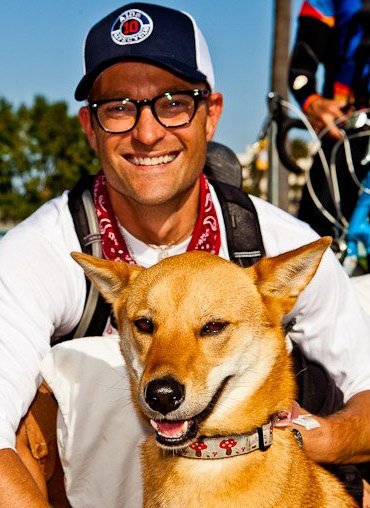 |
| Allen with his dog Foxie Brown |
I have been involved with AIDS Project Los Angeles as an actor/fundraiser for over 20 years participating in countless events here in LA. But after riding in six AIDS/life-cycles (545 mile bike rides from San Fran to LA to raise money for the LA Gay and Lesbian Centers HIV/AIDS services), I was looking for a new challenge and service opportunity that wouldn't take me away during finals.
I had done my first triathlon and T2 (Team to end AIDS) was doing their first triathlon to benefit APLA. I signed up, trained and that got me into running for the first time in my life... I actually had a spinal disk rupture during tri-training and had surgery before that first tri, and I wasn't able to race. To be honest I didn't know if i'd ever run or bike again. Committing to the idea of raising money for APLA and running the Disney half marathon in winter 2013 gave me a goal to get through the endless recovery and physical therapy. I ran that race for APLA, and it was amazing. For my 40th birthday I wanted to find an awesome challenge to raise some real money with. When the Sydney marathon came up, since I've always wanted to go to Australia and I've never run a marathon before. I knew I was in.

Tell me about the members of your team, how did you guys get together?
The team is a very small group of high fundraisers, all of whom -- I believe -- have run marathons before. I am actually the only first timer. Eeeek. They're a fantastic and supportive group of about 10, mixed gender, age, sexuality and skill levels specifically brought together for their passion and ability to raise good amounts for the cause.
How long is the marathon?
26.2 miles. Olympic marathon distance and the course we are running is the same as the Sydney games a few years back. They say its extraordinarily beautiful!
Have you been to Australia before?
Nope. It's a dream of mine since I was a kid. Everyone who knows me and knows Australia says I'll want to stay. I've heard that my whole life. I can't wait!
Thursday, July 24, 2014
Department of Justice Urges States To Drop HIV Criminalization
The Civil Rights division of the U.S. Department of Justice is strongly urging legislators across the country to strike down laws that currently criminalize HIV-positive people who, often unknowingly, “certain behaviors before disclosing known HIV-positive status.”
HIV criminalization laws sprang up across the country in the early days of the AIDS epidemic when diagnoses and death were swift and sometimes unexpected. In a time when the exact means of transmission were misunderstood and means of treating those infected were scant, the laws were a desperate attempt to curtail the spread of the virus. More robust public health funding was provided to the states in 1990 provided that the states criminalized HIV transmission.
Unfortunately, most of the laws regarding HIV positive individuals and their conduct haven’t managed to keep pace with the development of treatments. Put simply, the laws just don’t work. Last year the United Nations HIV/AIDS prevention task force found that in criminalizing HIV transmission these laws discouraged people from finding out their HIV statuses.
“Generally the best practice would be for states to reform these laws to eliminate HIV-specific criminal penalties except in two distinct circumstances.”
The DoJ’s guide reads:
First, states may wish to retain criminal liability when a person who knows he/she is HIV positive commits a (non-HIV specific) sex crime where there is a risk of transmission (e.g., rape or other sexual assault). The second circumstance is where the individual knows he/she is HIV positive and the evidence clearly demonstrates the individual’s intent was to transmit the virus and that the behavior engaged in had a significant risk of transmission, whether or not transmission actually occurred.
Friday, July 18, 2014

AIDS researcher Joep Lange confirmed among dead in Malaysia jet shoot-down
Members of the international HIV research community are reeling from the news that many of their own, including world-renowned AIDS researcher Joep Lange, perished when Malaysia Airlines Flight 17 was shot down Thursday over eastern Ukraine.
The victims were on their way to the International AIDS Conference that begins this weekend in Melbourne, Australia, a trip halfway around the world that necessitated a change of planes in Kuala Lumpur.
 The identities of the victims have not been officially confirmed by the airlines. But Lange’s office in Amsterdam confirmed in a statement that he died in the crash.
Lange, a Dutch citizen, had been a pioneer in the field since the early days of the AIDS epidemic and had worked tirelessly, his friends and colleagues said, to improve access to life-saving drugs in impoverished corners of the globe.
“His loss casts a pall over the International AIDS Conference just getting underway in Melbourne,” wrote Daniel R. Kuritzkes, a professor of medicine at Harvard Medical School. He called Lange “an extraordinary leader, scientist and humanitarian” who, as a past president of the International AIDS Society and as a leading Dutch academic researcher, “fought ceaselessly for the dignity of all HIV-infected persons throughout the world.”
Thursday, July 10, 2014
How The Hobby Lobby Decision Could Undermine The Fight Against HIV/AIDS
The Supreme Court's decision in Burwell v. Hobby Lobby Stores, Inc. could pose a significant threat to the fight for broader access to comprehensive treatment for HIV/AIDS. The ruling, handed down last week, held that closely held, for-profit corporations could be exempt from laws in direct conflict with their religious beliefs.
Hobby Lobby took specific issue with four forms of contraception the Affordable Care Act required it to provide its employees through its healthcare. While the bulk of the Hobby Lobby conversation has centered around religious objections to contraceptives, Media Matters points out that similar arguments could be made against Truvada, a drug just as socially polarizing.
A form of pre-exposure prophylaxis, (PrEP) Truvada has proven itself to be an overwhelmingly effective means of blocking HIV infection when taken properly. With a 99% efficacy rate, an endorsement from the CDC, and increasing deployment in public health initiatives, Truvada has the potential to be a key component in halting new HIV infection rates.
As Carlos Maza points out in Media Matters, however, the conversation around Truvada bears a striking resemblance to the debate about birth control. "[T]he Truvada debate recalls the way birth control was viewed in some quarters in the 1960s -- as an accessory to promiscuity."
Subscribe to:
Posts (Atom)
