Showing posts with label Testicles. Show all posts

Monday, April 28, 2014

Why testicular cancer self-examinations matter

Testicular cancers are the most common tumors of men in the age range of 20-35 years. Then there is another peak of testicular cancer in men who are age 60 and older.

Testicular cancer is not extremely common. There are only about 5-6 cases per 100,000 men per year in the US. That’s about 10,000 cases diagnosed per year. What is alarming, is that these numbers have steadily increased over the past few decades and are still increasing. Between about 1990 and 2000, the incidence of testicular cancer increased by 100%.

The incidence varies by ethnicity, as well. White males have the highest incidence of testicular cancers at about 6.3/100,000 men. Then, in decreasing order, American Indians > Hispanics > Asians > African Americans. Interestingly, in Europe there are differences in neighboring countries (Finland 2.5 cases/100,000. Denmark almost 10 cases/100,000), and in different areas in the same country (in France, the rate varies from 2.8 cases to 7.9 cases/100,000 depending on the region.)

There’s an excellent video, below, that walks you
through how to do a self-exam for testicular cancer.
It seems that there are higher rates of testicular cancer in the more industrialized areas of North America and Europe. There are also some genes that are involved. Testicular cancer occurs more commonly in closely related male relatives of men with testicular cancer. Brothers and sons of affected men have a significantly elevated risk. Men with a history of previous testicular cancer, who had an undescended testicle, infertility, patients with genetic diseases (like Down’s syndrome) are at increased risk. There may be increased risk to men exposed to diethylstilbestrol (DES) while in utero, and men exposed to Agent Orange.

Monday, July 29, 2013

Why are testicles kept in a vulnerable dangling sac? It’s not why you think.

Soccer fans call it brave goalkeeping, the act of springing into a star shape in front of an attacker who is about to kick the ball as hard as possible toward the goal. As I shuffled from the field, bent forward, eyes watering, waiting for the excruciating whack of pain in my crotch to metamorphose into a gut-wrenching ache, I thought only stupid goalkeeping. But after the fourth customary slap on the back from a teammate chortling, “Hope you never wanted kids, pal,” I thought only stupid, stupid testicles.

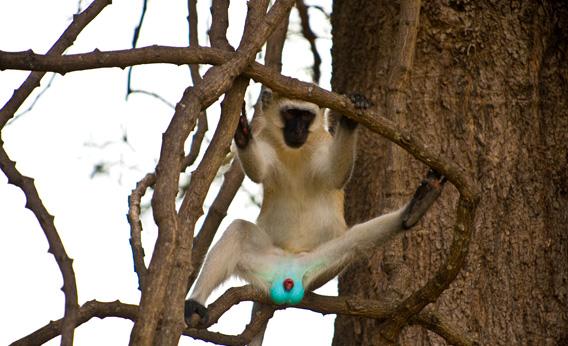
A Velvet monkey's neon scrotum.
A vervet monkey's neon scrotum  
Courtesy of Gijs Joost Brouwer
Natural selection has sculpted the mammalian forelimb into horses’ front legs, dolphins’ fins, bats’ wings, and my soccer ball-catching hands. Why, on the path from the primordial soup to us curious hairless apes, did evolution house the essential male reproductive organs in an exposed sac? It's like a bank deciding against a vault and keeping its money in a tent on the sidewalk.
Some of you may be thinking that there is a simple answer: temperature. This arrangement evolved to keep them cool. I thought so, too, and assumed that a quick glimpse at the scientific literature would reveal the biological reasons and I’d move on. But what I found was that the small band of scientists who have dedicated their professional time to pondering the scrotum’s existence are starkly divided over this so-called cooling hypothesis.
Reams of data show that scrotal sperm factories, including our own, work best a few degrees below core body temperature. The problem is, this doesn’t prove cooling was the reason that testicles originally descended. It’s a straight-up chicken-and-egg situation—did testicles leave the kitchen because they couldn't stand the heat, or do they work best in the cold because they had to leave the body?
Vital organs that work optimally at 98.5 degrees Fahrenheit get bony protection: My brain and liver are shielded by skull and ribs, and my girlfriend’s ovaries are defended by her pelvis. Forgoing skeletal protection is dangerous. Each year, thousands of men go to the hospital with ruptured testes or torsions caused by having this essential organ suspended chandelierlike on a flexible twine of tubes and cords. But having exposed testicles as an adult is not even the most dangerous aspect of our reproductive organs’ arrangement.

Read More
Related Posts Plugin for WordPress, Blogger...